Bitcoin didn’t just appear out of nowhere.
It was engineered to solve real problems: inflation, excessive banking fees, weak financial transparency, and a system that often favors institutions over individuals.
To understand why Bitcoin is revolutionary, we need to understand three core concepts:
- 🔐 Why blockchain security gets stronger over time
- ⛏️ How Bitcoin mining and halving work
- 🌍 Why cryptocurrencies may reshape the future of global finance
Let’s break it down in simple terms.
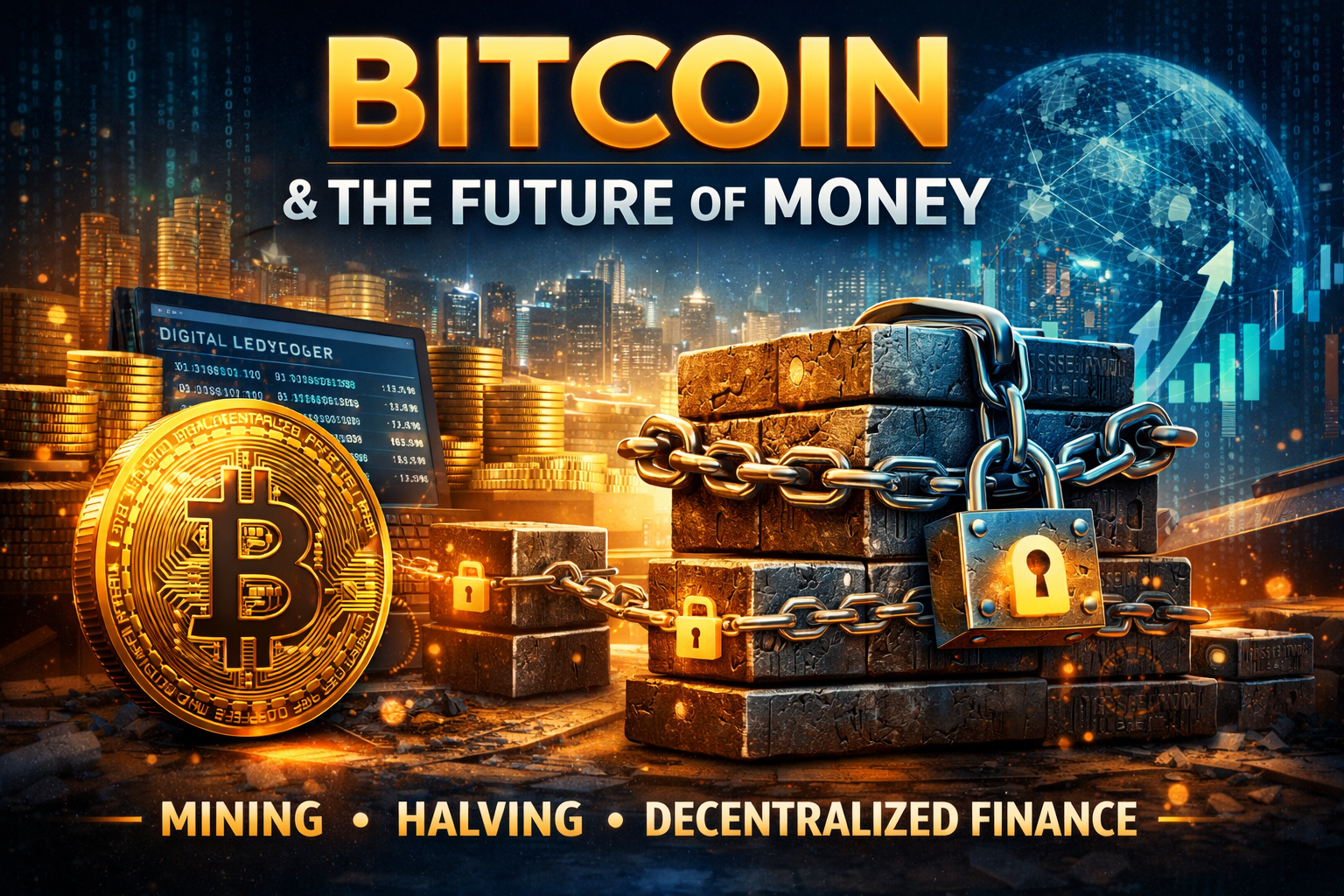
The Lock Analogy: Why Each Block Becomes More Secure
Imagine protecting something valuable.
You start with a basic padlock.
Then you add a stronger lock.
Then you reinforce it with multiple layers.
Then you bolt the safe into the ground.
That’s essentially how blockchain works.
Each new “block” added to the Bitcoin blockchain increases security.
Every block references the previous one, forming a chain.
If someone tries to alter one block, they would need to change every block after it which becomes exponentially harder over time.
This is why Bitcoin’s security strengthens as more blocks are mined.
The more participants securing the network, the more powerful and resistant to attack it becomes.
What Is Bitcoin Mining?
Bitcoin mining is the process of validating transactions and adding new blocks to the blockchain.
Miners compete to solve complex mathematical puzzles.
When a miner successfully solves one:
- A new block is added to the blockchain
- The miner receives a reward in Bitcoin
At the beginning, the reward was 50 BTC per block.
Then it was cut in half to 25 BTC.
Then to 12.5 BTC.
Then to 6.25 BTC.
This event is called the Bitcoin halving.
What Is the Bitcoin Halving?


Bitcoin’s code reduces mining rewards roughly every 210,000 blocks (about every 4 years).
This continues until the total supply reaches 21 million Bitcoin.
Unlike fiat currencies, where governments can print unlimited money, Bitcoin has a fixed supply written directly into its code.
According to the original whitepaper by Satoshi Nakamoto, once block rewards become very small, miners will primarily earn money from transaction fees instead.
This means:
- No endless money printing
- Predictable monetary policy
- No artificial inflation
By the 2030s, block rewards will be much smaller, and eventually Bitcoin issuance will effectively stop.
Scarcity is built in.
Why 21 Million Bitcoin Matters
Traditional currencies lose purchasing power over time because central banks can expand the money supply.
Bitcoin is different.
Only 21 million BTC will ever exist.
Once that cap is reached:
- No new coins can be created
- Inflation from new supply stops
- Miners rely on transaction fees
This is a fundamental shift from traditional banking systems.
Eliminating the Middleman
One of Bitcoin’s biggest innovations is removing intermediaries.
In traditional finance:
- Banks charge withdrawal fees
- Credit cards charge high interest
- International transfers can take days
- Services like Western Union charge significant fees
With cryptocurrency:
- Peer-to-peer transfers settle globally
- Fees are typically lower
- Transactions can happen 24/7
- Anyone with a smartphone can participate
More than 2 billion people globally are unbanked. Cryptocurrencies allow them to access financial tools without needing traditional bank accounts.
All they need is internet access.
Blockchain Transparency: A Public Ledger
Another powerful feature is transparency.
Every Bitcoin transaction is recorded on a public ledger (the blockchain). Anyone can verify it.
This creates:
- Trust without banks
- Auditable transaction history
- Reduced reliance on centralized institutions
Future applications could include:
- Election voting systems
- Smart contracts
- Vehicle leases
- Healthcare records
- Sports contracts
- Historical documentation
Blockchain technology is not just about currency it’s about secure, tamper-resistant records.
2008 Financial Crisis: The Catalyst
Bitcoin was born shortly after the 2008 financial crisis.
That crisis revealed:
- Major banks taking excessive risks
- Taxpayer-funded bailouts
- Executive bonuses despite failures
The collapse of trust in centralized institutions created the environment for decentralized alternatives.
Without 2008, Bitcoin might not exist.
Sometimes you need a storm to clear the sky.
Competition Is Good for Consumers
Think about technology.
If only one smartphone existed, innovation would stall.
If there were no competition between operating systems, consumers would still pay heavily for software upgrades.
Cryptocurrency introduces competition to fiat currencies.
And competition:
- Drives innovation
- Lowers fees
- Improves security
- Benefits consumers
Governments may eventually create their own digital currencies, but the presence of decentralized cryptocurrencies forces improvement.
Monopolies rarely innovate unless threatened.
Friction-Free Capitalism
Bill Gates once discussed the idea of “friction-free capitalism.”
Cryptocurrencies move us closer to that idea.
Transactions can:
- Occur instantly
- Cross borders effortlessly
- Bypass traditional bottlenecks
This reduces friction in global commerce.
For libertarians and financial independence advocates, this represents a massive shift in power from institutions to individuals.
The Future of Money
Imagine explaining traditional banking to your grandchildren:
- Paying fees to withdraw your own money
- Governments printing currency and diluting value
- Paying 20% interest on credit cards
- Waiting days for international transfers
- Paying accountants to calculate taxes
Cryptocurrency challenges all of that.
It creates:
- Predictable monetary policy
- Increased financial access
- Reduced reliance on centralized gatekeepers
- Transparent, verifiable systems
Will there be scams and volatility? Of course.
Every new technology has speed bumps.
But the long-term implications are profound.
Final Thoughts
Bitcoin mining strengthens the network.
Halving ensures scarcity.
Blockchain increases security over time.
Competition improves the financial system.
We are witnessing a financial power shift from centralized institutions to individuals.
Whether you invest or not, understanding how Bitcoin works is critical.
Because the future of money is already being written block by block.



Leave A Comment