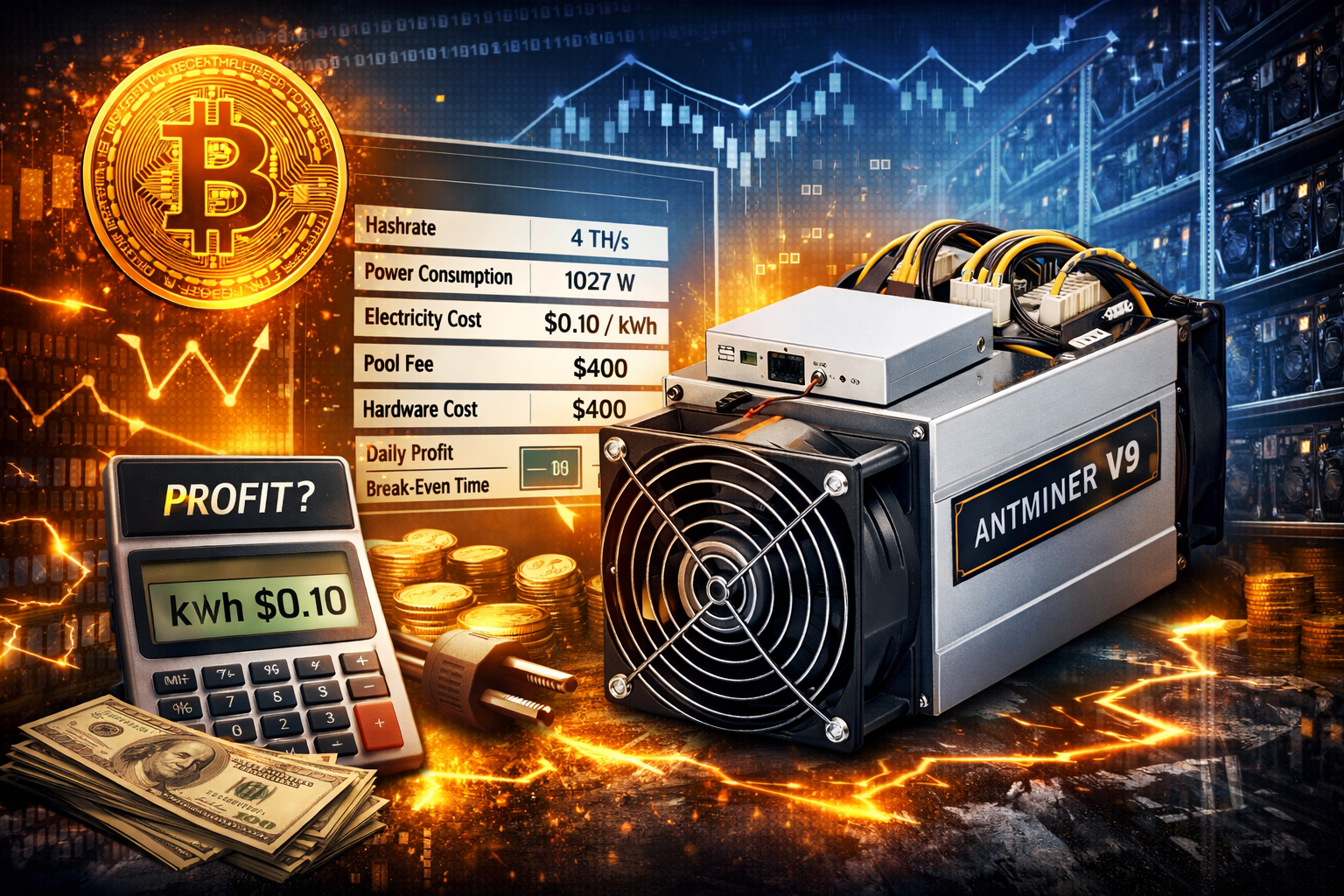
Before you even think about buying a Bitcoin mining machine, you must understand two things:
- The hardware specifications
- The true cost of electricity where you live
Mining is not about hype. It is about math.
In this guide, we will walk through how to evaluate an ASIC miner like the Antminer, calculate profitability using CoinWarz, and determine whether mining makes financial sense for you.
What Is an ASIC Bitcoin Miner?
Bitmain is one of the largest manufacturers of Bitcoin ASIC miners. Their most well known product line is the Antminer series.
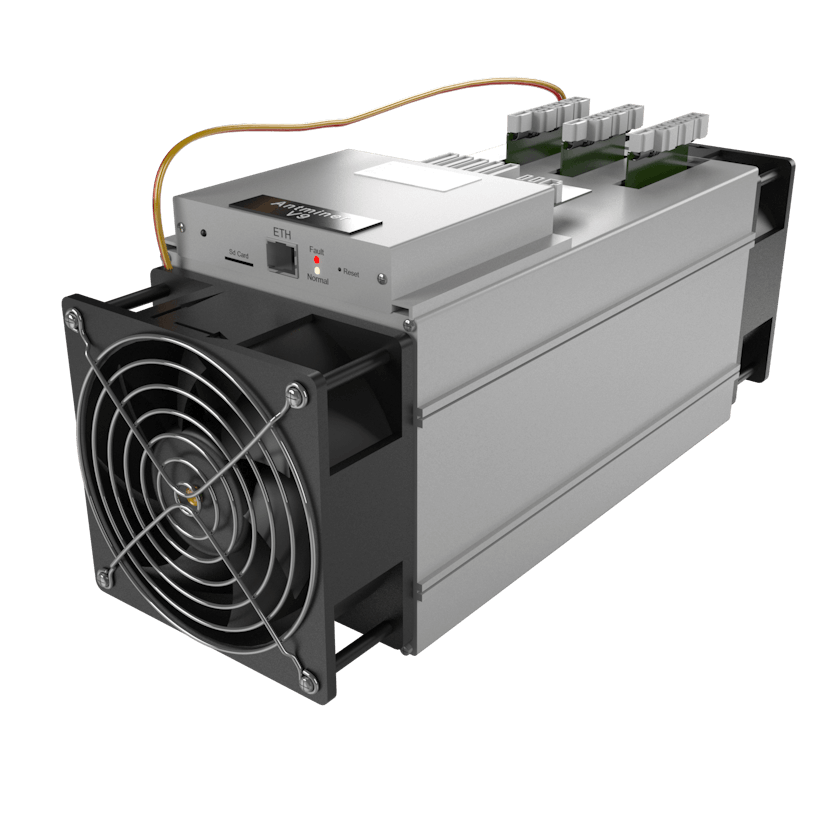
ASIC stands for Application Specific Integrated Circuit. These machines are designed to do one thing extremely well: mine Bitcoin using the SHA256 algorithm.
Unlike regular computers, ASIC miners are built specifically for high speed hashing and maximum efficiency.
One example is the Antminer V9, which delivers:
- 4 terahashes per second
- Approximately 1027 watts of power consumption
You can purchase these directly from Bitmain or through marketplaces like Amazon. Prices fluctuate frequently, similar to external hard drives or GPUs.
Why Electricity Cost Matters More Than Hardware
Many beginners focus on the price of the mining machine. That is a mistake.
The real cost of mining is electricity.
Let us break this down in simple terms.
What Is a Kilowatt Hour?
A kilowatt hour, written as kWh, is a unit of energy. It represents the amount of energy used if you run a 1000 watt appliance for one hour.
For example:
- A 1000 watt device running for 1 hour uses 1 kWh
- A 100 watt light bulb running for 10 hours uses 1 kWh
If electricity costs $0.14 per kWh, then:
- Running a 1000 watt device for 1 hour costs $0.14
- Running it for 10 hours costs $1.40
- Running it 10 hours per day for 365 days costs $511
Now compare that to an Antminer using roughly 1027 watts. That is essentially the same as running a 1000 watt device continuously.
Over time, electricity costs can exceed the price of the hardware itself.
Electricity Prices Around the World
Electricity rates vary dramatically by region.
For example:
- Some regions in China and India may pay around $0.08 per kWh
- Hawaii can exceed $0.30 per kWh
- Some US states average around $0.10 per kWh
It is no coincidence that large scale mining operations are often located in regions with lower electricity costs.
Before purchasing any mining equipment, you should:
- Check your latest utility bill
- Search for updated kWh pricing in your city
- Call your electricity provider
- Ask about time of use discounts
- Ask whether solar reduces your rate
This step alone can save you thousands.
Using CoinWarz to Calculate Mining Profitability
CoinWarz provides mining calculators that estimate profitability based on real time data.

Here is how to calculate profitability:
Step 1: Enter Hashrate
For the Antminer V9:
- 4 terahashes per second
- Equivalent to 4000 gigahashes per second
Hashrate measures how fast your miner solves cryptographic problems.
Units scale like this:
- H/s
- KH/s
- MH/s
- GH/s
- TH/s
Higher hashrate means more mining power.
Step 2: Enter Power Consumption
For the Antminer V9:
- 1027 watts
Step 3: Enter Electricity Cost
Example:
- $0.08 per kWh in low cost regions
- $0.14 to $0.20 in many parts of California
Step 4: Enter Mining Pool Fee
Most miners join mining pools. Typical fee:
- Around 1 percent
Step 5: Enter Hardware Cost
Example:
- $400 including power supply and shipping
The calculator then estimates:
- Daily revenue
- Electricity cost
- Net profit
- Break even time
Remember that all of these inputs change constantly. Bitcoin price, mining difficulty, and block reward adjust over time.
Understanding Mining Difficulty and Block Rewards
Bitcoin mining becomes harder as more miners join the network.
When Bitcoin price increases:
- More miners join
- Mining difficulty rises
- Individual profitability drops
Block rewards also decrease over time due to halving events. Historically, rewards dropped from:
- 50 BTC
- To 25 BTC
- To 12.5 BTC
- And continue decreasing over time
This is part of Bitcoin’s fixed supply design.
Bitcoin mining is therefore a moving target. Profitability today may look very different in a year.
Why Most Bitcoin Mining Happens in Low Cost Regions
Large scale miners operate in regions with:
- Cheap electricity
- Access to bulk hardware
- Industrial scale cooling
- Favorable regulations
Massive data center operators like Amazon Web Services also choose locations strategically based on energy costs.
Mining is capital intensive. Margins are thin. Electricity efficiency determines survival.
Should You Mine Bitcoin at Home?
Here is the honest answer.
If you live in a region with high electricity costs, mining Bitcoin with a single ASIC is usually not profitable long term.
It may make sense if:
- Your electricity rate is very low
- You have solar
- You buy hardware in bulk
- You mine at scale
- You treat it as an educational exercise
Otherwise, break even times can stretch into years.
In many cases, buying Bitcoin directly can be more efficient than mining it.
Key Takeaways Before You Spend a Dollar
- Always calculate electricity cost first
- Use CoinWarz to estimate profitability
- Understand mining difficulty increases over time
- Consider pool fees
- Call your electricity provider before buying hardware
- Compare mining versus buying Bitcoin directly
Mining is math. Not emotion.
If you understand electricity cost and hardware efficiency, you can make rational decisions about whether to mine Bitcoin or not.
In the next step, once you are confident in your numbers, you can move forward with configuring your Antminer and connecting to a mining pool.
Make the decision based on data, not excitement.




Leave A Comment